 ®
®







.jpg)








 Competition Structure
This structure took effect from October 2008 and was designed to encourage long-term development of good practice (see National Priorities) rather than fast-tracked difficulty. One of the biggest changes was the introduction of wider age bands where competitors had attained a common level of development. The old 6 competition grades, themselves divided into 6 age bands were replaced by 9 levels (grades), only 7 of which are competed at a regional or national level, initially with limited age differentiation. As before, male and female do not compete against each other in formal competitions. All those entering Regional or higher level competition must meet a minimum age requirement in the year of the competition. Since then there have been a few changes and, in particular, additional age groups have been introduced.
The new structure has a new 'competition season' introduced for all grades for the first time (previously only Grade 1 had a recognised season). This season takes place between January and July with either a national or regional competition taking place approximately every 3 weeks. There is also an additional 'off-season' regional event in October. The picture above right shows the new grades; A, B & C will compete together nationally at gala events alongside DMT and, eventually tumbling and GMPD, whilst D, E, F & G will compete regionally - progression (and regression) between grades A - D will no longer be based on attainment of qualifying scores but will instead be based on a percentage of the top-ranked performers being eligible to try out at the next grade whilst a percentage of the lowest-ranked may be relegated (see below).
Age differentiation has changed sicne teh structure was introduced and is now as follows:
- A (or more correctly FIG A) – there will be just one senior group, with Men's and Ladies competitions, with a minimum age of 15 (promotion can only be attained through FIG B Senior competition);
- B, C & D (correctly FIG B, National C & Regional D) – comprise three age groups known as Youth (U15), Juniors (U19) and Seniors (O19) and - minimum age in year of competition is 9;
- C now has two additional age groups, U13 & U17 although promotion is not possible from these groups to FIG B
- E, F & G (remaining regional assessment grades) - are now at regional discretion - minimum age in year of competition is 6. Eastern region added an under-13 age group in addition to the originally required under-15 and over-15 age groups;
- H & I - These are capable of being assessed within clubs and to date Eastern Region has made no provision for including such assessments at regional competitions - minimum age in year of competition is 6.
Movement between grades
Qualification system for Regional D & above is as follows:
Any competitor finishing within the promotion zone is eligible (but not required) to compete at the next grade; should they compete again at their old grade they will then lose the option unless again finishing in the promotion zone. Any competitor finishing in the relegation zone will be issued a caution which will be removed should they avoid the relegation zone in their next competition - on collecting two cautions, however, the performer will be demoted to the lower grade. The 2010 competition handbook states that the top 20% (subject to meeting a minimum score) or meeting an enhanced score may trial at the next grade. Minima are 51.0 from FIG B, 50.0 from National C and 49.0 from Regional D; enhanced scores are 55.0, 54.0 & 51.0 respectively). Relegation points are given to the bottom 20% of FIG A, FIG B and National C if their scores are also below 57.0, 51.0 or 50.0 respectively and also to any performer failing to complete both their routines.
Qualification for other regional grades is as follows:
Qualification to the higher grade will be achieved through attaining a qualifying score over two rounds. Leap-frog qualification is also possible from Regional G to E and Regional F to D. The current qualifying scores as:
- From G to F - 45.0 (no tariff applied),
- to E - 48.5 (no tariff applied),
- From F to E - 47.5 (including tariff),
- to D - 50.5 (including tariff)
- From E to D - 49.5 (including tariff).
At present qualification at one competition with one of the set routines is permissible although (i) coaches are encouraged to ensure that performers can complete all moves to a good standard and (ii) it is intended in due course that performers will need to qualify twice, once with each of the set routines.
Voluntary relegation
There will also be a process to permit 'voluntary relegation' for those no longer wishing to compete at a given level. The context of announcements to date is such that this is principally targeted at grades A - C where performers may demote themselves for a number of reasons including, for example:
- Loss of moves;
- Not competitive at the higher level;
- Has achieved a qualification to national finals at a previous level and wishes to compete at that level but moved up a level during the season.
Other than the 3rd item, these factors would appear to apply equally to lower grades.
Log Books
BG has also issued a Log Book which is designed for performers to use to track their progress through the grades starting from H all the way through to A. The log book also provides useful clarity about how BG expect travel and loss of height to be assessed. At present the log book is optional although is likely to become compulsory in due course with some aspects of it being tested during the 2008/09 competition season. The full log book can be downloaded from here, extracts addressing individual grades can be found here.
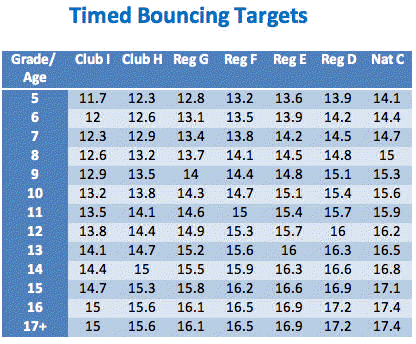
Timed Bouncing
Targets are set for 'Timed Bouncing' with a requirement to meet an age-based target before progressing to the next grade. These are summarised in the chart below:
Routines
The full set of routines can be viewed here. These have been designed to make the lower grades more technically demanding and to ensure only those most capable progress to higher grades.
Where performers started in the new system
Where they started in this structure depended on grade and level of ability as at September 2008 and although there was a nominal mapping of old grades 2 - 6 against the new grades National C down to Club G (with Men's/Ladies' Grade 1 equating to FIG A and other grade 1s to FIG B), it was mainly based on the following table which more closely reflects the routines performers were familiar with:
| September 2008 grade | Probable start points | |
|---|---|---|
| Mens/Ladies | FIG A or B | |
| Grade 1 - over 13 | FIG B, National C or Regional D | |
| Grade 1 - under 13 | National C or Regional D | |
| Grade 2 - over 11 | National C, Regional D or E | |
| Grade 2 - under 11 | Regional D or E | |
| Grade 3 | Regional D, E or F | |
| Grade 4 - over 15 | Regional F | |
| Grade 4 - under 15 | Regional F or G | |
| Grade 5 - over 15 | Regional G | |
| Grade 5 - under 15 | Club H | |
| Grade 6 | Club I |
Most recently it has been announced that all competitors currently competing between grades 1 - 4 will choose which grade they want to map to, in effect this could be anywhere between A - G. Those who have not competed before or have only competed at grade 5 or below are expected to start in the new system at grade G. No tracking of Club grade competition will be undertaken by BG.
This synopsis has been provided following review of:
- the original announcement available by downloading the document from here;
- the presentation given at Nationals which is also available for download by clicking here;
- the February 2008 announcement of new routines available for download (compete with original typos) here;
- the May 2008 update provided at the Cardiff Gala is available for download by clicking here;
- further May 2008 update clarifying and adjusting certain announcements from Cardiff;
- the Regional Handbook Supplement providing further clarification of rules and qualifications which is available for download by clicking here;
- the BG Trampoline Competition Handbooks 2009 & 2010 which are available here & here respectively.