 ®
®







.jpg)








Sir Isaac Newton
The importance of Newton’s three laws relating to application of forces to motion have never been underestimated when it comes to trampolining and yet in searching the Internet I've found no resources that describe the importance of these laws in a trampoline context. Since I consider Newton to be “Boss man” of trampolining the following is my attempt to explain the laws in a manner accessible to performers. But first, who was this guy any way?
Mini-Biog.
Isaac Newton was born in the year of 1642, and died in 1727 – he was born on either Xmas Day or January 4th depending on which biography or calendar you read. He was most famous for his three laws of motion, but was also known for other major discoveries in maths and science. He compiled most of his work into a masterpiece of science called the Principia, some people claim that only 50 people in history have been able to understand his style of writing (but probably fewer beginner trampolinists understand the implications of his work on trampolining). At the age of 18, he had devised a new system of mathematics called Calculus, and developed three laws which resulted in a new way of understanding motion. All of this happened at his farm while the Black Plague swept across England. In the Principia, Newton claimed to have "discovered" gravity when an apple fell on his head. But, many now believe that this was just a story told by Newton, and that in real life, he discovered gravity through thinking - not seeing.
In coaching new moves (all the way from basic to advanced) all coaches build on basic applications of Newton’s work whether or not they realize it.
3 Laws of Motion
All trampolining moves are governed by one or more of the 3 Laws of Motion – even the most complex have a relationship with the most basic and these form ‘progressions’ from which new moves can be learnt. For example, the correct understanding of basic swivel-hips can be reflected in a Barani (intermediate) or Rudi-out (advanced).
The law of inertia
The first basic law of motion is that of inertia and although this is known as Newton’s 1st law it was originally stated by Galileo Galilei. Much simplified the law says that:
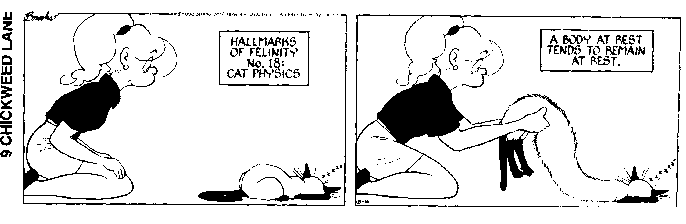
If no force acts on an object, the object will continue moving at the same speed in the same direction. If the object is stopped, it will remain at rest.
 What
this means is that any change of motion (e.g. start, stop, speed up or slow
down), can only occur if a force is applied to the object. A very crude example
is why a driver is thrown forward in a head-on accident. The car may have
stopped, but the driver continues moving forward unless held in place by a
seatbelt.
What
this means is that any change of motion (e.g. start, stop, speed up or slow
down), can only occur if a force is applied to the object. A very crude example
is why a driver is thrown forward in a head-on accident. The car may have
stopped, but the driver continues moving forward unless held in place by a
seatbelt.
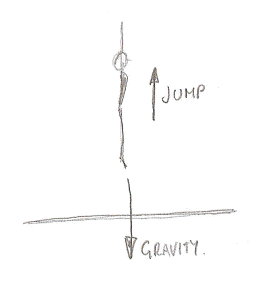
In trampolining terms, one way of thinking about this is that once we've started bouncing on a trampoline we keep travelling upwards until Gravity (an external force) pulls us back down again – just out of interest, at the very point at which we stop going up and start coming down again we are effectively weightless (which is why coaches are often able to move performers around in mid-air with relatively little effort – it isn't superhuman powers honest).
The law of acceleration
The second of Newton’s laws refers to acceleration. Again, simplified the law says:
An object accelerates because a force acts on it and the stronger the force, the greater the acceleration. The acceleration will be inversely proportional to the mass of the object given the same force.
To understand this law, imagine pushing a stone, and then imagine pushing a rock. The stone has a smaller mass, and so will get faster (accelerate) quicker than the rock will. Now imagine pushing a rock with your bare hands and then imagine pushing it with a JCB. The JCB is able to exert more force on the rock, and so will make it accelerate faster than when you pushed it with your bare hands. This law also needs to take account of how the amount of force is relative to the mass of the object – the heavier the object the (much) harder the force required to achieve the same effect.
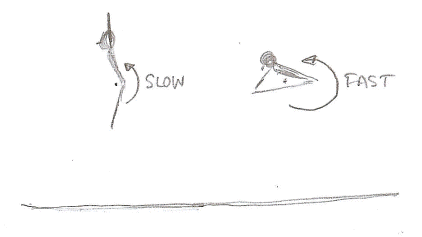 In
trampolining the most usual application of this law is in relation to rotation
and twisting where the effect relates to that of using a lever to move a rock.
With a lever and fulcrum it has been said (by Aristotle I think) that with a
firm place to stand and a long lever it would be possible to move the earth. In
the pictures on the right we can see the very long levers of the top and bottom
halves of the body exerting large forces that can work against the somersault
rotation at the hips; in the second picture though the levers are reduced
substantially and so the somersault accelerates much more quickly.
In
trampolining the most usual application of this law is in relation to rotation
and twisting where the effect relates to that of using a lever to move a rock.
With a lever and fulcrum it has been said (by Aristotle I think) that with a
firm place to stand and a long lever it would be possible to move the earth. In
the pictures on the right we can see the very long levers of the top and bottom
halves of the body exerting large forces that can work against the somersault
rotation at the hips; in the second picture though the levers are reduced
substantially and so the somersault accelerates much more quickly.
The law of reaction or counterforce
An important property of forces is that they always have to act between two 'bodies' in contact. An unusual application of this that is quite useful to trampolinists is when a body is freely suspended in space and not in contact with anything else; in this case the action and the reaction have to be between two different but connected parts of the same body.
Simply stated this law says:
When one object applies a force on another object, the second object applies an equal force on the first object. The two forces are always equal and opposite.
If you do a jump on floor, you must first propel yourself by pushing away from the floor (or in other words, pushing the floor away). You can't perceive it, but the floor (which is part of the building, which is part of the world) responds by pushing you away from it - we simply perceive this as a resistance since, frankly, we aren't going to shift the world very far even if we all gathered in one place and tried jumping at the same time. It is as a result of both your push against the floor and the world's equal and opposite push against you, that propels you into the air.
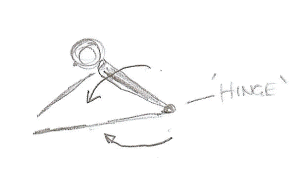 A
good and simple example of where this becomes useful to trampolinists is where a
performer is in the air executing a pike jump. The body is effectively in
two parts (top and bottom) joined by a hinge (the hips) and when the top half
presses down and forwards then, in the absence of any other forces being
applied, the only ‘free’ body available to react is the bottom half of the body
which lifts in reaction as can be seen in the picture to the right. To
work properly, of course, you must be in the air when you try to start the shape
since reaching forward whilst still in contact with the bed will simply cause
you to travel in that direction.
A
good and simple example of where this becomes useful to trampolinists is where a
performer is in the air executing a pike jump. The body is effectively in
two parts (top and bottom) joined by a hinge (the hips) and when the top half
presses down and forwards then, in the absence of any other forces being
applied, the only ‘free’ body available to react is the bottom half of the body
which lifts in reaction as can be seen in the picture to the right. To
work properly, of course, you must be in the air when you try to start the shape
since reaching forward whilst still in contact with the bed will simply cause
you to travel in that direction.