 ®
®
















Competition organisation & judging
Not intended to be a definitive guide, the following was produced to help some local schools arrange an inter-school competition using officials and organisers who had not previously been to a trampoline competition. As such it serves as a useful beginners guide. The page is broken into the following sections:
- Introduction
- Planning
- Roles
- Judging (& how to get the best from judges)
Introduction
To run effectively, a trampoline competition requires a substantial organisation activity including officials, equipment, safety mats and a host of other things easily forgotten. This document identifies the roles and activities involved in a competition and provides some useful points of reference. At the end of the day, however, experience is everything and the more practiced you become in fulfilling the required activities then the smoother the competition organisation. This paper addresses specifically:
- the planning of a competition
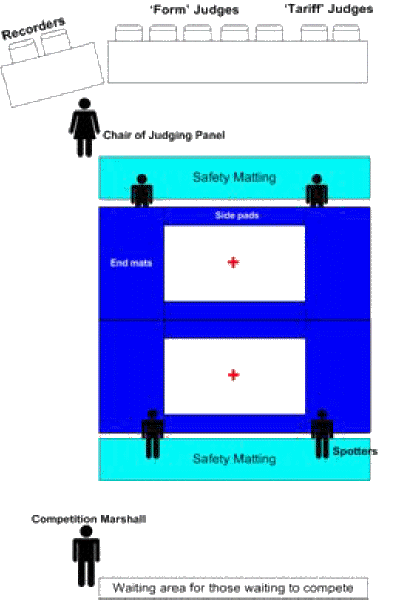
- the organisation required to support one ‘panel’, a panel typically comprises two trampolines set out as illustrated in Figure 1 below, together with associated officials – a competition can comprise a number of panels, and
- how routines are judged
It is worth noting that competitions normally run in up to 3 ‘rounds’ being:
- Compulsory, or Set round, in which each performer competes an identical routine,
- Voluntary round in which each performer can compete a routine of their own construction (although comprising only legitimate moves) and often with some constraints on the overall level of difficulty, and
- A Final round in which the highest scoring performers (typically up to 8) will compete in a second Voluntary round
… although in local, friendly or other low-level competition it is rare for there to be a Final round.
Planning
When planning a competition there are a number of key points to consider:
- Equipment and consumables,
- Do you have all the equipment necessary to run the competition and is it fit for purpose? If not where can you acquire the extra kit you need?
- How long will you need to set the equipment up?
- Do you have enough tables and chairs for officials and audience?
- Do you have benches or mats for performers to sit on whilst waiting to compete?
- Do you have suitable barriers or other demarcation between the competition zone and audience?
- Do you have sufficient score cards for the number of judges you will require?
- Do you have scrap paper and pens/pencils for the judges to use;
- Do you copies of the programme with competitors listed by name in competition order for the Competition Marshall & Chair of Judges to use?
- Do you have team & individual recording sheets pre-printed for each competition group with competitor names listed in competition order;
- Do you have calculators for the recorders to use if they are not skilled at mental arithmetic?
- Facilities,
- Are the facilities suitable to allow for audience as well as participants?
- Is the ceiling high enough to allow for the level of trampolinist competing?
- Are there ample toilet and changing facilities close to the competition venue for both performers, officials and audience?
- Are refreshments available during the competition for officials?
- People,
- Do you have enough officials?
- Do you have enough ‘suitably experienced’ helpers to set up the competition equipment and facilities and then take them down again afterwards?
- Who will be checking that all performers/teams are as previously advised – are there any substitutions/withdrawals etc…?
- Timetable,
- Have you allowed enough time for each competitor to warm-up
adequately and compete two (or three) rounds of competition?
- As a rule of thumb – BG competitions normally allow from between 4½ to 6½ minutes per competitor for 2 rounds of competition and associated warm-ups with 4½ being enough for novices and 6½ being required for advanced performers – with inexperienced judges more time may be required;
- In timetabling each group have you ‘randomised’ the order in which competitors will be asked to compete?
- Have you allowed for setting up and taking down again?
- Have you allowed some time in case things go wrong?
- Have you allowed enough time for each competitor to warm-up
adequately and compete two (or three) rounds of competition?
- Safety Issues,
- All competitors and officials must be familiar with the basic safety
rules:
- Appropriate attire = soft, no buckles, toggles or hoods. Feet covered (socks). Long hair tied back. NO jewellery.
- Appropriate behaviour = competitors should follow all instructions immediately, staying at side of trampoline watching colleagues whilst waiting go, one per trampoline only, no going under the trampoline, only attempting skills instructed.
- Appropriate fitness = inform an official at once of any health issues that may affect your participation or if hurt whilst trampolining.
- All equipment and facilities must have adequate safety procedures in place.
- All competitors and officials must be familiar with the basic safety
rules:
 |
|
|
There are several groups of officials to consider for each panel as follows – these are presented in the order that the performer might experience their activity:
Competition Marshall
Once a competition group has finished the Chair of Judges or Competition Marshall will call the next group of competitors to warm-up. During this time, the length of which will depend on the number of competitors, performers are allowed to try either of the two trampolines allocated to a panel and are expected to warm up both set and voluntary routines as they need.
Performers and their coaches are expected to ensure that all have a fair opportunity to warm up both their set & voluntary routines although where one bed is preferred over the other it is likely that those using the less popular bed will get more practice opportunity.
Each warm-up go should only be long enough to complete a routine after some preliminary bounces plus possibly enough time to repeat a single skill that caused a problem – any additional time ought to be an exception and abuse of this can result in deductions being made to the performers score.
Once the warm-up time has elapsed the Competition Marshall takes over and the timetable now rests largely on this person’s shoulders! They will normally start by sitting the performers down in their competition order, thereby verifying that they are indeed all present, and briefing everybody on the importance of listening for their name and ensuring that they have spotters available when they go to either warm-up or compete.
As well as the preliminary warm-ups each competitor normally has one further 'one touch' warm-up before competing in which they can elect to do either a set or voluntary routine (most competitions now keep groups quite small and large groups will be split up into 'flights' in order to facilitate this). This additional warm-up takes place before the compulsory round after which the Competition Marshall’s role is to ensure that the performers are ready to compete at the right time, are correctly dressed and have the correct number of spotters with them, the competitors will then each perform their set routines and then, after all sets are complete, their voluntaries without further intervening warm-ups.
Spotters
In the layout shown in Figure 1 above each trampoline should have 2 spotters positioned so as not to interfere with the judges view, and dressed in sports clothing with no jewellery (or other objects potentially able to harm somebody falling against them) during the competition phase. The Spotters’ role is to watch the performer at all times in case they need help to stay on the trampoline if in difficulty, and possibly to use the push-in mat if it is required. During the warm-up phase all competitors ought to be spotting when not warming-up. Spotters ought to be tall enough to see the trampoline clearly, have been instructed on rudimentary safety issues and be at least a similar size as those competing – they can be colleagues or team-mates of those performing. It is competitors’ responsibility to ensure they have adequate spotters although Competition Marshalls will not allow the performers to start bouncing if they do not have them.
Chair of Judges
This is the other vitally important role which, if performed poorly, can result in the competition falling into disarray! The Chair of Judges’ role is to ensure that each performer is correctly identified and complying with all safety requirements, that the judges are ready to mark them and that the marking is then carried out fairly and in accordance with a number of rules. In order to ensure the fairness of judging the Chair of Judges should organise some test judging during the latter phases of warm-ups and use those results to help the judges align their scores more readily. They may also explain some decisions to the performer where they might be unexpected or likely to cause upset. If any other judge is performing poorly the Chair of Judges can direct them to change how they are marking or ask them to leave the judging panel – any judge regularly more than 0.5 higher or lower than other judges might be questioned in this regard. Some specific examples of the rules that the Chair of Judges would be expected to monitor are:
- That the performer does not take excessive time before starting their routine;
- All landings are safe and, in the case of foot landings, not on one foot;
- That, in the event of an invalid landing or unsafe move, all moves including that landing (e.g. contact with a side pad or end mat) are not counted and relevant deductions advised to judges;
- The routine comprises 10 valid moves and, if not, to advise the judges of the error(s) and relevant deductions.
- At the end of the competition group their final responsibility is to check and sign-off the Recorder Sheets and ensure they are passed to the competition organiser.
Judges
Competitors are judged on both style and substance depending on whether it it is the Set or a Voluntary round (a 'final' is normally no more than a second voluntary round and scores from it are added to the combined scores from the prior rounds other than in the highest levels of competition where finalists start from zero points). At most regional competitions the tariff judges are the ones whose scores appear inexplicable to those new to competition since they are never in the same ballpark as those of the form judges.
Form Judges
- Five 'form' judges score execution. They start with a theoretically perfect score of 10 points (1 whole point for each move) and deduct points for faults in the routine. The highest and lowest scores are discarded, and the middle three scores are added for a possible maximum of 30 points. It is quite normal for scores to vary by up to 1 whole mark (highest to lowest) occasionally although tighter marking than that is, of course, preferred. The form judges score all rounds of competition. A guide to how the deductions are made for form are shown in the deductions section.
The 5 Form Judges’ role is to provide as objective a view as possible of how well each performer performs each move of each of their routines taking into account, in particular:
- Failure to arm-set where required;
- Inconsistent height;
- Travel around the bed away from the cross;
- Poor formation of shape being performed (i.e. straight, pike or tuck) in the move;
- Poor phasing of the move.
They will do this by allocating each of the 10 moves (also known as contacts) a score deduction of between 0 (perfect) to 0.5 (very poor indeed) – see Form Deductions below. Once they have marked all 10 contacts they will then add them up and deduct the total from 10.0 (if the Chair has advised that the routine was performed correctly with 10 moves) – this then becomes their score before any deductions are taken into account. Once any deductions are taken into account the Form Judges will then be asked to raise their scorecards for the Chair to read out for the benefit of the Recorders who will use the mid-three scores in calculating the performers actual score.
Tariff Judges
The (typically) two Tariff Judges’ role requires much more experience than a Form Judge since they need to recognise each move as it occurs as well as pass judgement on it!
During the Compulsory or Set round they will check that each move is as prescribed and, if the performer varies from the set routine, to advise the Chair of Judges of the error – the Chair will then instruct the Form Judges as to what deductions to make.
During the voluntary round, however, the Tariff Judges need to calculate the difficulty of each move as it occurs ascribing 0.1 for each quarter somersault and half twist plus additional bonuses for certain shapes and completed somersaults. Repeated moves, however, have no difficulty allocated at all. During the voluntary round the tariff judges will also raise a score card for the Chair to read out after first confirming that both have the same score if there are two, and, if not, analysing their marks for error; this score will depend on the grade of the performer and can vary from as low as 0.7 to as much as 15 for full international performers. For grades D and above performers are required to provide a Tariff Sheet (signed by a suitably qualified coach) to the Tariff Judges to use as a guide - the tariff sheet will list both set and voluntary routines.
Recorders
The Recorders’ role is to mark down the scores as they are called out by the Chair of Judges, either by computer or by hand, asking for clarification immediately if they are not clear, and then to calculate the individuals’ and any team scores. The individual score is calculated by taking the 5 scores and then adding up the three mid-scores (i.e. discounting the highest and lowest) – in the Set round this sum becomes the performers Set Form Score. In the Voluntary round the Tariff, or Difficulty, score is added to the calculated Form Score to create the aggregate Voluntary Score. In the event that any judge (or judges) fail(s) to provide a score the recorders will take an average of the given scores and use this average in its/their place – perversely this means that one of the given scores will be discarded whilst the average score will count.
After each performer’s score has been calculated the aggregate score for that round is also copied to the appropriate team recording sheet.
 |
|
Figure 2 - An example of a recording sheet |
In some competitions there will be a computer recorder as well as a manual recorder - the results from these are intended to be calculated separately and then compared after each sum has been completed to guard against errors; the manual recorder also protects against a computer crash.
Once all have competed the performers’ ranking is decided based on the aggregate of the Set Form Score and Voluntary (& Final) round Score(s) – in the event of a tie there are detailed tie-break rules that are applied iteratively until a clear decision is arrived at. As at 2010 BG dictates that the tie-break is determined by the following precedence:
- Performer with highest voluntary round score;
- Performer with highest form scores in voluntary (or final) round;
- Performer with highest form scores (all 5 judges' scores counting) in voluntary round;
- Performer with highest form scores (4 highest judges' scores counting) in voluntary (or final) round;
- Performer with highest form scores (3 highest judges' scores counting) in voluntary (or final) round;
- ... etc... until tie is broken
 |
|
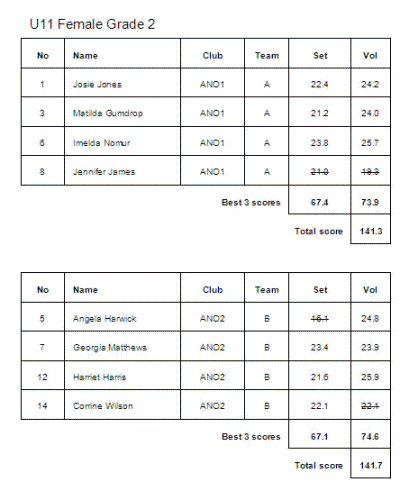
Figure 3 - An example of a team recording sheet |
After each round the three highest scoring team members’ scores are added together to create the score for that round – these may be three different members in each round – and then the aggregate for each round added together to give a team total which is used to determine the teams’ rankings.
Again, in the event of a tie there are detailed tie-break rules that are applied iteratively until a clear decision is arrived at. BG 2010 rules break ties in the following precedence:
- The team with the highest sum of the 3 highest total scores of the voluntary;
- The team with the highest sum of the 2 highest total scores of the voluntary;
- The team with the highest total score of one of the voluntaries.
Judging
Form Deductions
Each move in a 10-bounce routine has the potential to earn 1.0 mark for quality of form. As mentioned above, up to 0.5 can be lost for failure to satisfy the judges that the move was performed perfectly, this deduction is calculated by reference to six key criteria for execution:
|
0.0 - 0.1 pts 0.0 - 0.2 pts 0.0 - 0.3 ptsd 0.0 - 0.2 pts 0.0 - 0.2 pts 0.0 - 0.2 pts |
There is a comprehensive table of deduction guidelines used by judges as reference point as to how these deductions are calculated. It is worth pointing out here that there are no specific guidelines for, for example, front drop or seat drop – assessment of these moves is made on the basis of how straight the body line is in the air, whether arms/fingers and legs/toes are all pointing in the right directions etc… – the table of deductions allow for all these aspects to be assessed.
However, before we start looking at these ‘what is a move?’ Strictly speaking a move comprises a single contact with the trampoline and starts as the performer leaves the trampoline after a prior move and finishes when they next contact it. A front drop, therefore, is a single contact – from feet to front landing – but has an implied second move being from the front landing to feet. Similarly a swivel hips, often expressed as though ‘a move’ is, in fact, three moves (i) from feet to seat, (ii) from seat half twist to seat, and (iii) from seat to feet. For new judges, getting this right is often the biggest challenge. Bear in mind that all routines must start and end with the performer standing in an upright position on 2 feet!
Getting the best response from judges
 This very useful guide was written by Stephen Blair. It is
fair to say that it is really quite accurate and although I (webmaster) tend to
agree with those who have commented that Judges ought only be concerned with the
performance and not be swayed by winning smiles; after all - Judges are only
human.
This very useful guide was written by Stephen Blair. It is
fair to say that it is really quite accurate and although I (webmaster) tend to
agree with those who have commented that Judges ought only be concerned with the
performance and not be swayed by winning smiles; after all - Judges are only
human.
What judges look for
I do not claim to be an authority on trampolining, but in my time as a coach I have seen a lot of errors, and here are the remedies I have found. Over time I hope for this to become a resource that coaches and performers can look at to see why marks are being lost. This page is intended to deal with what judges look for at competitions:
Smile
Seriously smile. When you get on the trampoline, you will be expected to present yourself to the judges. When you present yourself, smile. This pleases the judges and they tend to enjoy the routine. There is nothing more disheartening than a trampolinist looking unhappy. Also when you end the routine and present yourself to the judges, remember to smile again.
Ending the routine
When you stop bouncing at the end of a routine make sure you stand still, after the last bounce, for 3 seconds. This is to show the judges that you have landed and not stumbled or fell at the end. Make sure you stay for the full 3 seconds, so you do not get any end of routine deduction. [webmaster's note: I favour the 5 elephants approach to counting this off but it's amazing how small some kids make those elephants!]
Centred
When you perform any move during the routine, try and land on the cross, in the centre of the bed. If you travel forwards or backwards or even sideways, you may lose points. If you can stay in the centre of the trampoline you should not loose marks for travel.
Loss of height
During your routine it is important not to lose height. Try and keep at a constant height throughout the 10 moves and it may be useful to use the tuck, pike and straddle jumps to regain height. It is important that these moves are performed well, however, as you are being marked on them. If you however, choose to do a seat drop or or back drop or front drop in a routine, then you are allowed some loss of height, but are expected to regain about 75% or your original height.
Keep your legs together and point toes
When performing any move except the straddle jump, it is important to keep the legs together. This will make the move feel better when it is done, but also looks nicer to the judges. Also point the toes when bouncing. Again this improves the looks of the move and can help keeping the legs straight.
The seat drop
When performing a seat drop it is important to have the fingers pointing towards the toes. The judges will also notice if you are leaning back or not.
Back drop
When doing a back drop it is very easy for the recoil of the bed to bring you back up to your feet. However this is not correct as this can cause travel and also looks untidy. The judges look to see if you try and kick out of the back drop, with the kick coming from the hips, and 'hopefully' to a centred landing.
Pike and straddle jump
When performing these moves it is important to get the moves correct. It is important to ensure the legs are lifted enough. It is a common problem for the legs to be pointed down instead of horizontal.
© Stephen Blair