 ®
®







.jpg)








The Back to Front Link
Here, as promised in the last edition of Gymcraft, are my thoughts on the technical aspects of linking a backward rotating move to a forward rotator.
Readers may recall I highlighted the commonly held view that this is an easier combination than linking back to back. Whilst not disagreeing, I was concerned that this simplicity of execution led to a lack of technical focus and the embedding of poor technique, ultimately limiting the gymnast’s ability to maintain height throughout a routine. I intend to look at the correct technique and timing of this combination before offering a set of learning progressions to be undertaken at an early stage of a gymnast’s development.
First let us look at why there is a problem and I will use the combination Back S/S Tucked to Front S/S Tucked as an illustration. The gymnast dropping towards the bed from a Back S/S will have a clear sight of the bed thus giving an early warning of the impending “landing” and subsequent “take off” for the forward somersault. Before the perceived “landing” has occurred, the gymnast will already be mentally preparing for the front somersault to follow. As the first contact (the perceived “landing”) occurs, the gymnast will believe they are in an effective posture to enable forward rotation to take place. Even if we assume that the performer allows the bed to depress fully, it is highly likely their posture, instead of being upright, will be bent forward in a shallow pike as they prepare to create forward rotation, This sequence is shown is Fig 1.
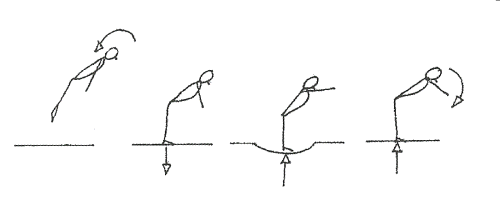
Fig 1
It is a logical sequence and, if you like, the “natural” way to create a back to front combination. Despite this initial ease of execution there are several undesirable side effects which can have far reaching implications.
- A loss of height compared to the previous somersault is inevitable
- The commensurate loss of airtime prevents deep shaping and amplitude on exit
- There is a strong chance of travel as the body “falls” forward into the Front S/S
- There is a strong chance of the gymnast shunting the hips backward to create the forward rotation leading to a serious gain
As a coach, you may decide to accept these downsides in the early stages of learning the combination in exchange for the initial ease of performance. I would warn against this because, as I hope you will see from the suggested progressions, there is a better way without risking long term technical damage. At this point let me draw your attention to the fact that no performer in the world currently executes back to front combinations in a voluntary routine without displaying some of the side effects listed above.
Fig 2 Is sampled from Alexander Rusakov’s winning routine. Of course it is not a bad example but serves to illustrate that even the world’s best can improve.
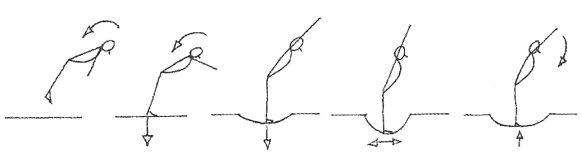
Fig 2
By all means let us look at the World Champion as a role model but that shouldn’t stop us from striving to do even better, which may involve breaking new ground. It is the attitude which took Roger Bannister below the four minute mile mark when most experts believed the feat to be beyond the bounds of human physiology. The Late Paul Luxon took our sport to new levels causing one American coach to dub him ‘Britain’s Grand Master of the lmpossible!” These fine examples should be stimulating our coaches and gymnasts to take on the challenge of addressing areas where we can get an edge over our much vaunted opponents.
So let me aim for perfection and start by analysing what I believe to be the ideal technique and timing for a back to front link. This should ensure the forward somersault is at least as high as the preceding back somersault, is without travel or gain and enables phasing and amplitude to attract a zero deduction. The key to success lies in the coach teaching the gymnast that the first contact on the bed after the back somersault is simply the start of the landing phase and not the “landing” per se. The back somersault has not finished until the bed is fully depressed and the gymnast is standing tall with the arms fully overhead. This process is shown in Fig 3.
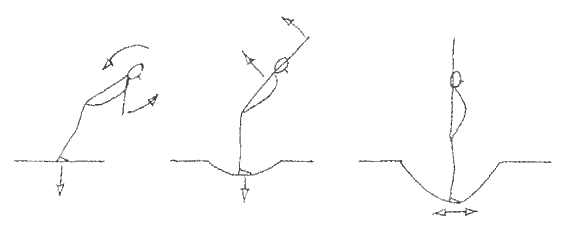
Fig 3 (Landing phase)
The gymnast must be taught at an early stage that the back somersault is required to do the same job as an arm set when a front somersault is performed from straight jumping.
In other words its purpose is to create the perfect platform for the best possible front somersault take off. The gymnast must maintain the upright posture as the bed begins to rise, leaving the actions which create the forward somersault as late as possible and even then, applying only the minimum force required. This having been achieved, we will now have a take off phase where the maximum vertical force had been obtained form the recoil of the bed resulting in sufficient airtime to compensate for the underplaying of rotational input. Fig 4.
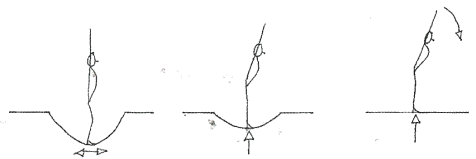
Fig 4 (Take off phase)
Teaching the Back to Front Link
I hope I don’t have to remind coaches that the linking of somersaults should not be considered until the individual elements, when performed from an arm set, can be performed consistently with direction, height, control and vision. As stated in the “National Technical Priorities” (NTP) document — “Direction must precede connection”. The emphasis on vertical direction brings with it the benefit of enabling a deeper tucked or piked shape in the subsequent somersault. One of Britain’s leading personal coaches (name withheld to protect the identity of this modest individual) sums it up as “steeper leads to deeper!”
Assuming the foregone conditions have been complied with, I recommend proceeding as follows:
- Back S/S, out bounce. There should be no travel on the out bounce which should attain a height at least equal to that of the back somersault. This is consistent with the NTP statement ‘every take off is simply a modified straight jump’.
- Repeat progression 1 and add a well timed arm set on the descent from the out bounce showing similar height and absence of travel.
- Repeat progression 2 and add a tightly shaped tuck jump at the top of the second out bounce. Stress to the gymnast that the tuck jump is a simulation of a Front S/S tucked.
- Repeat progression 3 but replace the tuck jump with a high well directed front somersault tucked. Once again there should be an absence of travel and because of the strong vertical component, the tuck should be tight, permitting sufficient rotation to enable a well extended exit. Stress throughout that the gymnast is preparing to use the back somersault as a replacement for the arm set and as such it must be just as accurate and well placed as the arm set. The gymnast must be taught to perceive the “finish” of the Back S/S as the moment when they have arrived at maximum bed depression, standing erect and with the arms directly overhead.
- Now for the real challenge! The gymnast attempts to perform the Back S/S tucked with the same characteristics displayed in the previous progressions. The Back S/S must be performed as accurately as before, allowing it to “finish” at maximum bed depression in a replica of an accurate arm set. (Gymnast upright with arms reaching directly overhead). The tendency will be for the gymnast to either resist the achievement of the upright posture at max depression or, if that is indeed attained, fail to wait until the bed begins its recoil upward.
- OK, I was lying! The real challenge is, having acquired the technique to such a level that it can be transferred to major combinations within a competitive routine. For example: Double back/Baranl, Half In, Half out/Half out. Or in the case of our National Men’s Champion Simon Milnes, Half in, Half out Triff/ Rudi out Triff!
As with all descriptions of progressive practises, I am acutely aware that simply going through the stages does not guarantee the desired result. [Webmaster note: the published article contained a typo suggesting the process is guaranteed - it is not; these things rarely are!] The list of steps suggested simply offers a ‘tool” for the creative coach to use in the pursuit of his/her vision of the perfect skill or combination.
Both coach and gymnast must possess the vision, belief and determination to pursue such ultimate levels of skill.
I started by outlining the problem and stressing the need for new ground to be broken, I then outlined my vision of ideal technique before suggesting a process for its acquisition.
Do you share my vision?
Do you believe it is attainable?
Have you the determination to pursue this particular level of skill?
I live in hope.
© Jack Kelly